Argentina’s Unbreakable Spirit Crushes England’s Final Dream
Just when it seemed England were on the verge of ending their 60-year wait for another World Cup final, Argentina produced yet another stunning late comeback. Inspired by their trademark resilience, the defending champions turned defeat into victory in dramatic fashion, booking a place in the final against Spain.
There is something almost inevitable about this Argentina side. For the fourth consecutive knockout match, Lionel Scaloni's men stared elimination in the face, absorbed the pressure of a team determined to end their reign, and somehow found another escape route. Against England in the World Cup semi-final, it arrived later than ever, but it arrived all the same.
Two goals in the closing minutes turned impending heartbreak into jubilation as Argentina came from behind to defeat England 2-1, booking a place in a second consecutive FIFA World Cup final where Spain now awaits. It was another chapter in what is becoming one of the tournament's defining narratives.
Cape Verde dragged them into extra time in the Round of 32. Egypt established a two-goal advantage before Argentina authored one of the greatest comebacks in World Cup knockout history. Switzerland, despite playing with ten men for almost 20 minutes, pushed the defending champions beyond 90 minutes in the quarter-finals.
England became the latest side to discover that leading Argentina means very little until the final whistle sounds. If the previous knockout victories highlighted Argentina's resilience, this one showcased their patience.
The semi-final began exactly as anticipated. History, rivalry and the magnitude of the occasion produced an opening period dominated less by attacking invention than by relentless physical confrontation. Every challenge carried significance. Every duel seemed personal.

Neither side wanted to become the first to blink. Jude Bellingham found himself constantly surrounded by blue-and-white shirts. Lionel Messi was repeatedly halted through tactical fouls whenever he attempted to accelerate into dangerous spaces. Elliot Anderson's heavy challenge on the Argentine captain typified a first half where intensity outweighed technical quality.
The statistics reflected the stalemate. England managed just a single effort before the interval, while Argentina created little beyond speculative attempts from distance. The expected-goals numbers barely registered. It was football stripped to its competitive essence.
Yet England quietly believed the contest was unfolding exactly as Thomas Tuchel had envisioned.
Their physicality was disrupting Argentina's rhythm. Declan Rice and Bellingham controlled central areas, while Djed Spence produced another energetic display down the left. The match appeared increasingly likely to be decided by one decisive moment.
That moment arrived ten minutes after the restart. Jordan Pickford first denied Julián Álvarez at one end before England immediately launched the move that produced the breakthrough. Harry Kane's searching pass eventually found Morgan Rogers, whose measured delivery into the penalty area perfectly located Anthony Gordon.
The Newcastle winger remained composed, guiding his finish beyond Emiliano Martínez from close range. England erupted. For the first time since 1966, another World Cup final suddenly appeared within touching distance.
Perhaps no team in the tournament would have appeared better equipped to protect such an advantage. Tuchel had built England's campaign upon defensive organisation, tactical discipline and physical endurance. As Argentina searched for an equaliser, England increasingly retreated into a compact defensive block. Initially, the strategy appeared effective.
Spence produced a remarkable recovery tackle to deny Giuliano Simeone following a dangerous Argentine counterattack. Pickford reacted brilliantly to prevent Leandro Paredes from equalising. Every clearance, interception and save strengthened England's belief that history was finally about to favour them. But against Argentina, defending for extended periods carries enormous risk.
Scaloni's side possess an unusual ability to sustain pressure without becoming frantic. Rather than flooding the penalty area with hopeful deliveries, they patiently manipulated spaces around England's increasingly deep defensive line. Wave after wave followed. Alexis Mac Allister crashed a header against the post.
Enzo Fernández tested Pickford from distance. Messi drifted into central pockets searching for one opening capable of changing everything. England, meanwhile, continued sinking deeper.
Tuchel's decision to introduce an additional centre-back and switch to a back five prioritised preservation over ambition. Understandably so. But in doing so, England surrendered virtually all attacking threat, inviting Argentina to spend the final quarter almost exclusively inside their half.
Eventually, the pressure became unbearable. Five minutes from time, Argentina worked a clever short corner routine involving Messi before Enzo Fernández unleashed a spectacular strike from outside the penalty area. The finish was magnificent.

The significance even greater. The equaliser transformed the atmosphere instantly. England's composure evaporated. Argentina sensed vulnerability. Once momentum shifts against defending champions of this pedigree, reversing it becomes almost impossible.
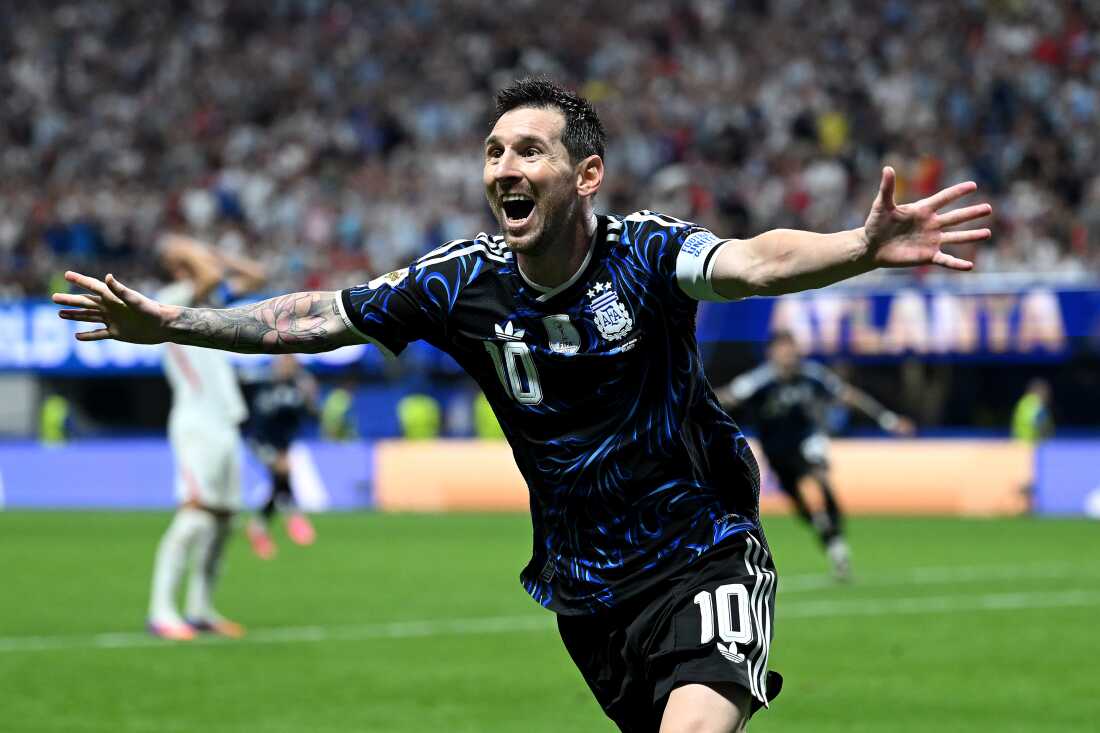
Deep into stoppage time came the decisive blow. After Mac Allister had once again struck the woodwork, Messi gathered possession wide on the right and delivered one final invitation into the area. Waiting beyond England's defensive line was substitute Lautaro Martínez. His movement created just enough separation. His header supplied just enough precision. Argentina completed another impossible comeback. The celebrations reflected more than simply reaching another final.
They represented the latest triumph of a group that continues to refuse to accept defeat, regardless of circumstances. Throughout this tournament, Argentina have repeatedly looked vulnerable. Opponents have exposed weaknesses, dominated periods of matches and placed the reigning champions on the brink.
Yet nobody has managed to finish the job. That speaks to qualities statistics rarely capture. Belief, experience and composure. And, perhaps above everything else, the enduring influence of Lionel Messi.
At 39, the Argentine captain no longer controls matches through relentless dribbling or explosive acceleration. Instead, he dictates moments. His intelligence, movement and decision-making continue determining football matches at the highest level. Even after a relatively subdued evening by his extraordinary standards, it was Messi's delivery that created the winning goal. Great players require only one decisive action.
England, meanwhile, leave the tournament carrying another familiar burden. This defeat joins a catalogue of agonising near-misses stretching across generations. From West Germany in 1990 to Italy at Euro 2020 and now Argentina in 2026, England has once again come within touching distance of history, only to watch it slip away in the closing moments.

For long periods, they executed their game plan impressively. Their defensive organisation frustrated Argentina. Their physical approach unsettled the champions. Their goal rewarded an intelligent tactical performance.
But tournament football is often decided not by who controls the longest periods, but by who owns the decisive moments. Argentina did it again..
Now only Spain stands between the Albiceleste and consecutive World Cup titles. Judging by everything witnessed over the past month, writing off this extraordinary team, regardless of the scoreline or the circumstances, feels increasingly like football's most dangerous mistake.
Source: TrendyBeatz