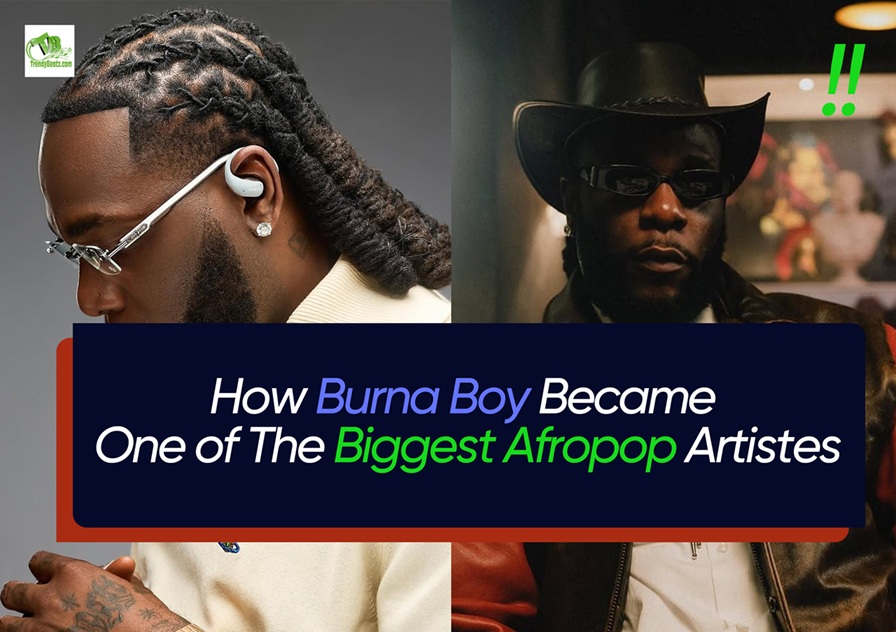
How Burna Boy Became One of the Biggest Afropop Artistes
Burna Boy just released his new album titled No Sign of Weakness, and it is really telling how he has continued to push through all odds, growing steadily to become one of the biggest Afrobeats artistes from Africa.
The title of the album doesn’t just reflect his confidence; it reflects his journey as well. Over the last decade, Burna Boy has evolved from a young outsider with a rebellious voice to a leading figure in global pop culture. His music is not just entertainment - it’s a catalogue of emotion, defiance, reflection, and cultural memory. In a landscape that often rewards noise over nuance, Burna Boy has insisted on doing things his way.
Born Damini Ebunoluwa Ogulu in Port Harcourt in 1991, Burna Boy’s relationship with music began early. His grandfather once managed Fela Kuti, and his mother, Bose Ogulu, later became his manager and a central figure in his rise. Burna studied in the UK for a while, but Nigeria always pulled him back, both physically and creatively. When he emerged into the Nigerian music scene in 2012 with “Like to Party,” he sounded nothing like his peers. Where others leaned heavily into fast-paced club beats, Burna’s sound was laid-back, smooth, and almost tropical. That debut single carried a quiet confidence: “When I dey on my own, dem no dey see me…” It wasn’t just a flex—it was a warning. Burna was building something different.
His 2013 debut album, L.I.F.E (Leaving an Impact for Eternity), confirmed his promise. Songs like “Run My Race,” “Yawa Dey,” and “Always Love You” blended Afrofusion, reggae, highlife, and R&B into something fresh and emotionally layered. He wasn’t afraid to sing about struggle, about women, about dreams and pride. However, the industry, especially in Nigeria at the time, was not fully prepared for someone so unfiltered and sometimes difficult to categorise. After parting ways with Aristokrat Records, Burna Boy went through a period that felt like a quiet dip. He was still making music, his 2015 album On a Spaceship had strong songs like “Soke” and “Rizzla”, but the momentum felt slowed, as if he was trying to locate something that had gone missing.
What came next would change everything. In 2018, Burna Boy released Outside, marking the beginning of a new phase. The album was tighter, more focused, and more precise in its voice. It had global appeal without sacrificing local flavour. The standout single “Ye”, which went viral partly due to name confusion with Kanye West’s album, became an anthem. In it, Burna sings, “I no get time for no enemy…,” a line that expresses the exhaustion of fighting unnecessary battles, especially in a country that doesn’t always reward talent on time. “Ye” was both a celebration and a lament. It marked a turning point—not just for Burna, but for Nigerian pop culture. He had made a song that felt as relevant in Lagos as it did in London, as danceable as it was defiant.
With the spotlight now firmly on him, Burna Boy released African Giant in 2019. The album was a bold declaration of identity. It wasn’t just about being African - it was about owning that identity loudly and clearly on the world stage. The title itself came from a real moment of frustration, when Coachella organizers listed his name in small font on the festival poster. Burna responded by calling himself an “African Giant,” and then built an entire album around that mindset. The project included tracks like “Dangote,” where he sings, “Dangote still dey find money o, I no dey shame to dey hustle.” The line struck a chord across Nigeria and beyond, naming the quiet struggle behind the smiles. Burna was no longer trying to fit into the Afropop formula—he was expanding its boundaries.
Songs like “Gbona,” “Collateral Damage,” and “Anybody” combined social commentary with sleek production. In “Another Story,” he critiques colonial history and Nigerian politics: “My country shackles me from birth…” It wasn’t common for a pop star to go this deep and still top the charts. But Burna Boy proved that Afropop didn’t have to be shallow to sell.
He followed up African Giant with Twice As Tall in 2020, produced in part by American music mogul Diddy, and featuring artists like Stormzy and Chris Martin. The album leaned further into his global identity. It blended dancehall, hip-hop, and Afrobeats with a spirit of resistance and reflection. “Monsters You Made” tackled issues of race and oppression. “23” was a quiet tribute to greatness, inspired by basketball legend Michael Jordan. And in “Way Too Big,” Burna rapped with almost untouchable confidence: “I be king, I’m the best my generation ever seen.” The album earned him a Grammy Award for Best Global Music Album, making him the first Nigerian solo artiste to win in that category. It was a win not just for him, but for a new vision of African pop—bold, self-aware, unafraid.
But even at the height of his global fame, Burna Boy has remained emotionally raw. His 2022 hit “Last Last” is one of his most vulnerable records. Built around a sample of Toni Braxton’s “He Wasn’t Man Enough,” it tells the story of a failed relationship and the grief that followed. “She manipulate my love, oh…” he sings, bare, broken, and honest. The track reminded listeners that even a man who sings about power and legacy is not untouched by pain. And perhaps that’s part of his strength - he does not hide his contradictions. He lets them breathe in the music.
No Sign of Weakness, his latest album, continues that thread. While early reviews are mixed on the strength of its singles like “Love” and “Born Winner,” what remains clear is Burna Boy’s commitment to evolution. The title alone feels like both a warning and a confession. It suggests that the journey is still ongoing, that despite fame, he is still proving something not just to the world, but to himself.
Burna Boy’s rise is not just a personal story. It is also a blueprint. He has shown that it is possible to be rooted in Nigeria and still be global. That you can sing in pidgin, Yoruba, and English, and be heard in Tokyo, Toronto, and Tottenham. That you can make music for your people and still bring the world to your doorstep. He has inspired a generation of artistes—from Rema to Tems to Asake, to aim higher without watering down their voice. And through all his controversies, interviews, brash statements, and viral moments, he remains, above all, an artist deeply tied to the power of sound.
From “Like to Party” to “Ye,” from “Dangote” to “Last Last,” and now No Sign of Weakness, Burna Boy has built not just a discography, but a mirror. A mirror that reflects who we are, who we’ve been, and who we might become. In doing so, he has not only become one of the biggest Afrobeats artistes from Africa, he has become its most compelling storyteller.
Source: TrendyBeatz